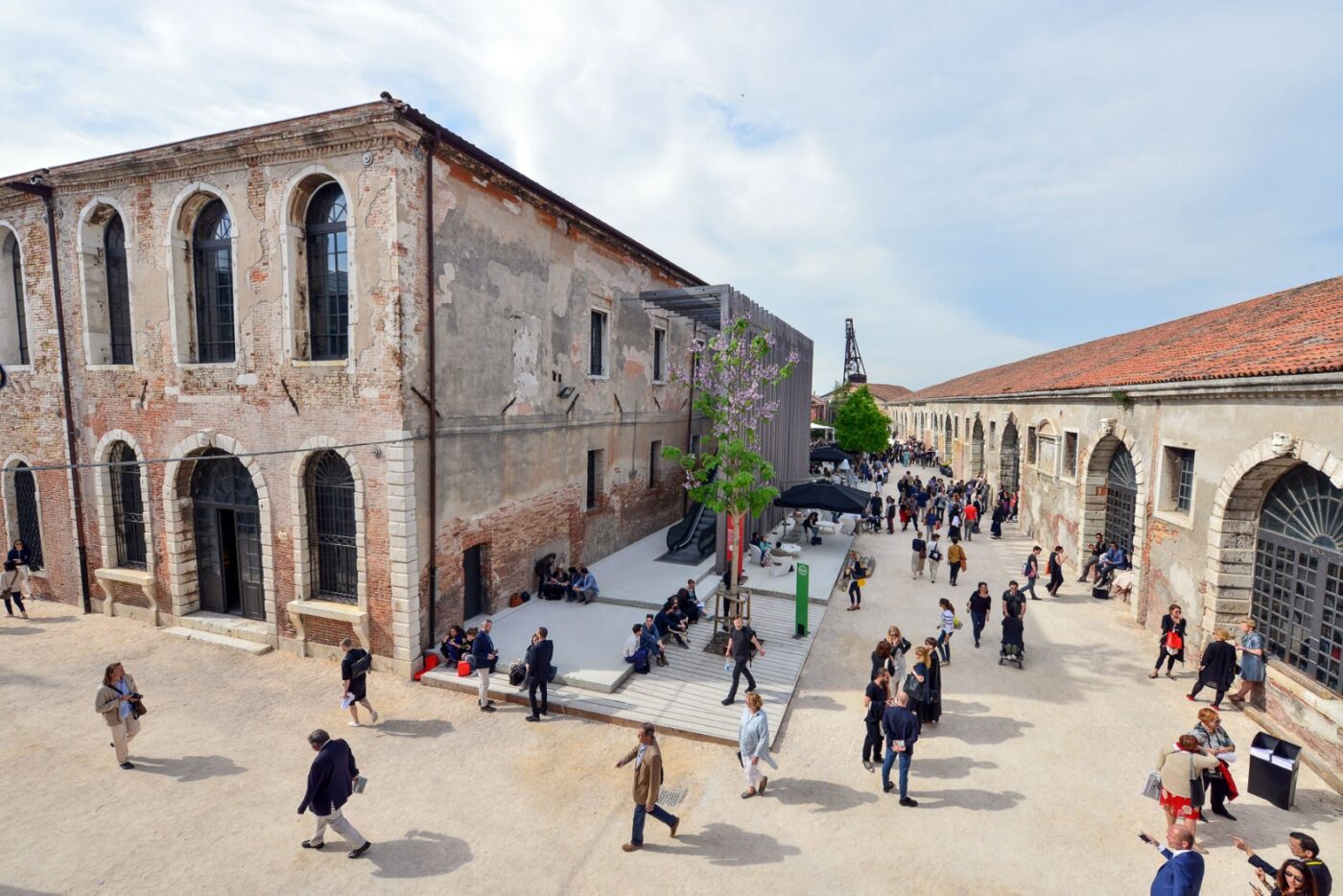
In the Arsenale, on the first floor of the Sale d’Armi, the Republic of South Africa’s pavilion will remain empty this year. The Russian Federation’s pavilion, closed since 2022, might on the other hand reopen — although the latest news seems to cast doubt on this possibility. The pavilion’s commissioner, Anastasia Karneeva, through her company Smart Art, submitted a formal request to participate, and the Biennale accepted the project.
All hell broke loose. Twenty-two European countries protested vehemently against the Russian presence, and the European Commission threatened to cut the Biennale’s funding. This happened just days after the Paralympics, where Russian athletes not only competed but won gold medals and stood on the podium to the sound of their national anthem.
Scuola of St. George and St. Tryphon (Scuola degli Schiavoni), Interior
I don’t remember exactly when I first visited the Scuola degli Schiavoni. But I do remember the emotion.
Walking in felt like falling into history.
In the small hall, with its wooden ceilings and wainscoting along the walls, Carpaccio’s canvases appeared like a fairytale frieze.
Darkened by time and poorly lit, yet never had I felt so strongly the presence of a world reaching out from the distant past.
The Dalmatians
Today renamed the Scuola Dalmata di San Giorgio e San Trifone, the Scuola degli Schiavoni was a charitable and solidarity institution for the many Dalmatians living in Venice.
The connection with Dalmatia, the region on the eastern shore of the Adriatic, had ancient origins, preceding even the political bond formed when it became part of the Republic’s Stato da Mar. Since the 11th century, in fact, the waterfront in front of the Doge’s Palace, where Dalmatian merchants docked and sold their goods, had been called the Riva degli Schiavoni.
In the intimate space of Scuola, which represented the Dalmatian community, Carpaccio brought to life a pictorial cycle that is both narrative and poetic.
St. George
The three canvases on the left recount the legend of Saint George, the archetype of the many wandering knights in our literature and a virtuous Christian soldier.
While near the city of Silene, the saint spots a young woman—a princess—offered to the voracious dragon that held the city hostage and constantly demanded new victims. Without hesitation, Saint George engages in battle with the monster to save the princess.
In the second canvas, Saint George drags the dragon, wounded but still alive, to the main square of Silene. Perhaps he already had an agreement in mind with the king. In fact, only after securing the king’s promise to convert to Christianity does the dragon meet its final end, killed before the crowd that witnesses the power of the Christian warrior.
In the third canvas, the king and his daughter, kneeling before Saint George, receive baptism from his very hands.
Carpaccio thus selects three episodes from the legend, but through each of them, he tells us much more: palmette-patterned fabrics, leaves, and flowers of Byzantine, Moorish, or Chinese origin; musicians always present at important celebrations; Christian and Islamic architecture. He shows us the king, ready to offer his daughter in marriage to the hero; a flustered servant; crowds of onlookers, plants, and birds.
Through these details, so familiar to his contemporaries, Carpaccio tells the story of Venice itself and its inhabitants.
Carpaccio has been called a painter-narrator. We might also call him a storyteller, because for every scene one could compose a stanza and read it aloud.
Some see in Carpaccio the skill of a film director staging long takes. Yet, within the multiplicity of details and stories present in each canvas, at the center dominates a still image.
If we take the first episode, the most striking element is the red lance wielded by the knight, delivering his blow with a movement from right to left.
Behind the saint, we see the princess and a church atop a hill, along with other Christian symbols. Behind the dragon, instead, we recognize a Saracen city with a minaret.
The legend reflects itself in the real world: the dragon is no longer a symbol of the pagans but of the Saracens, while Saint George wears contemporary armor. It seems the chivalric idealization of the concrete and brutal war that, by the thousands, Venetians and Dalmatians had been fighting for decades against the Ottomans.
This is not just a legend, nor is it only about the present reality of the Venetian-Ottoman wars: a golden light envelops the two protagonists who, even amidst the violence of the clash, appear motionless in space, crystallized in an eternal present, a warning of the universal struggle between good and evil, destined to endure until the end of time, when Christ will finally return to Earth and triumph over evil.
Ereo and Ursula: the Betrothed
There is another work by Carpaccio where a single detail captures a universal moment: it is the meeting between Orsola and Ereo, in the Sant’Orsola cycle at the Gallerie dell’Accademia.
The princess of Brittany agrees to marry the son of the king of England, provided he converts to Christianity. After the ambassadors have made the arrangements, Ereo travels to Brittany. The two young spouses see each other for the first time. We find them, almost a detail within the enormous canvas teeming with figures. They look alike: beautiful, blonde, noble, dressed in precious garments, completely unaware of the tragic fate that awaits them. In the exchange of their first glances, they recognize each other: they are made for one another.
The intensity of their resemblance, alluding to the union of two souls into one body, had already been sung a few centuries earlier in the legend of Tristan and Isolde. It is the story of a prince and a princess who, by accident, drink a love potion. To love one another, they break all the rules of honor and propriety—but that’s how it is: against magic, one cannot resist.
In Venice, the legend was very popular, thanks to the trovatori, wandering poets who recited it in the city’s campi, drawing captivated audiences who listened, sighing. I like to imagine that, one day, among them was Carpaccio himself, and that the poet’s verses never left him: A man, a woman; a woman, a man:
Tristan, Isolde; Isolde, Tristan.
Here, in this play of exchanged names and words, the poet weaves the fate of the two noble lovers, who, reflecting one another, become a single essence.
Carpaccio, a painter of stories, knew how to give shape to the deepest and most universal of emotions.
Giovanni Bellini, Presentazione di Gesù al Tempio, 1460-64, Pinacoteca Querini Stampalia
It is not just crimson, purple, or scarlet. Venetian red is something more: it is indefinable. Layered hues, transparent lacquers, and warm, enveloping sensuality evoke the shifting glow of a candle flame, making surfaces vibrate with every play of light.
In the sacred themes of the Venetian Renaissance, red recalls the blood of sacrifice, martyrdom, and divine love—moments central to Christian tradition. In portraits and secular themes, however, it breaks free from symbolic meanings, expressing elegance, sensuality, and passion.
Red is a dramatic color that irresistibly attracts the viewer’s gaze, taking center stage. When worn, it commands attention, as if the wearer were performing under the spotlight: red must be worn with confidence.
Perhaps for this reason, it has always been a regal color, and in the collective memory of Renaissance Venice, the purple of Byzantine emperors was still vivid.
The noblest expression of red was visible everywhere: in the ancient mosaics of Saint Mark’s Basilica, in medieval altarpieces, and in the robes of senators. Reserved for solemn contexts and prestigious figures, by the 16th century it had also become prominent in private or allegorical portraits.
For the portrait of Laura, Giorgione applied delicate glazes ranging from red to the brown of fur, shaping the figure with a soft and natural light. The exposed breast, the fur edge brushing against the nipple, creates a strong charge of sensuality.
As in other enigmatic works by the artist, the identity of the figure remains unresolved: perhaps Flora, perhaps a courtesan, a nymph, or—as suggested by the laurel wreath—Laura, beloved of Petrarch. More likely, it is an auspicious portrait commissioned for a wedding.
The precious pigment was primarily obtained from cinnabar, a rare mineral containing mercury sulfide. Due to its cost, from the 13th century onwards, a chemical process using a mixture of mercury and sulfur—already known in China and the Islamic world—produced a similar pigment: vermilion. Easier to obtain and of more consistent quality than natural cinnabar, vermilion was widely used. Both pigments, thanks to their intensity and covering power, were employed in rendering drapery and fabrics.
These were often overlaid with transparent organic red lacquers, such as madder root lacquer, which gave red-orange and pink tones. Until the early 16th century, artists also used kermes, a red derived from an insect related to the ladybug, known since prehistoric times. Around 1520, cochineal—a new insect of the same family—arrived from Mexico on European markets, producing a lacquer of brighter color. With its transparency and intensity, cochineal quickly became popular among Venetian and Italian artists in general, who replaced kermes with this lacquer for brighter glazes.
Titian, Flora, 1515, Gallerie degli Uffizi, Florence
In Flora, Titian reached exceptional virtuosity in his use of red. While seemingly less prominent than in other portraits, delicate shades of pink-red and orange permeate the entire painting: from the young woman’s auburn hair to her flushed complexion, to the luminous highlights on the velvet mantle softly wrapping her. The moonlit sheen of her blouse accentuates her rosy skin and the folds of the velvet. Like Giorgione’s Laura, this young woman is likely an allegory; the roses she holds suggest Venus, the goddess of love, but she is generally identified as Flora.
In stark contrast to Flora’s sensuality is the portrait of Isabella of Portugal, painted by Titian more than thirty years later. It was a posthumous portrait of Charles V’s beloved wife, who died at 35, perhaps of exhaustion, after giving birth to their seventh child.
Titian, Isabella of Portugal, 1548, Museo Nacional del Prado, Madrid
Charles V’s request was less about remembering his wife’s true features and more about reaffirming her role as empress of the vast Habsburg empire beside him—a desire Titian fully understood. Gold, jewels, her hairstyle, and the play of light on the velvet of her garments and the curtain all convey the essence of royalty and Christian virtue.
The prayer book is open, and her gaze is lifted toward a point far beyond the viewer. Isabella no longer seems part of this world. Remote, like an icon, she appears to belong instead to the azure sky above the Dolomites that open behind her—a signature touch of Titian, who often referenced the land of his birth in his works.
The bodice is dominated by a deep red, likely created with cinnabar and cochineal lacquer glazes to intensify the tones and confer depth.
But red was no longer exclusive to queens and empresses, goddesses of love, or courtesans: noblewomen now favored this evocative and impactful color as well.
Paris Bordone, Portrait, 1550, Galleria Palatina, Florence
In Paris Bordone’s Female Portrait—he was a student and collaborator of Titian—the red of the dress imbues the unidentified subject with energy and an imposing presence. In the 19th century, critics believed her to be a Medici wet nurse, but the luxurious fabric, pearl necklace, and her bearing suggest a high social rank. The shimmering reflections on the velvet are achieved with lighter brushstrokes, simulating the play of light on the fabric.
A warmer, softer light illuminates her face, whose expression hints at a resolute character, as does her pose, with arms free rather than traditionally folded in her lap.
By the mid-century, Veronese brought greater freedom to the Venetian school, moving beyond the warm tones that had dominated from medieval altarpieces through the Renaissance heights of Bellini, Giorgione, Sebastiano del Piombo, and Titian, to name a few.
Paolo Veronese, Portrait, 1555, Musee de la Chartreuse, Douai, France
In this lady’s portrait—dated to 1565—while the velvet red remains saturated and dense, with some brighter highlights, the cool glazes of her blouse create a more ethereal effect and a complex interplay of colors. Her skin, though still tinged with pink according to Renaissance beauty standards, reveals cooler shadows achieved by blending light tones with touches of blue and gray.
The techniques of color experimentation, layering, and combining cinnabar, vermilion, and red lacquers would reach their peak in the 17th century in the Netherlands, with artists like Van Dyck and Rembrandt, aided by the advent of a new red: carmine cochineal, offering even more brilliant effects.
Venice had anticipated a trend that would span centuries, cementing its central role in art history. Red, with its infinite shades and symbolic power, remains one of the most evocative marks of this extraordinary artistic era, capable of achieving regal and sensual effects that continue to captivate art lovers today.
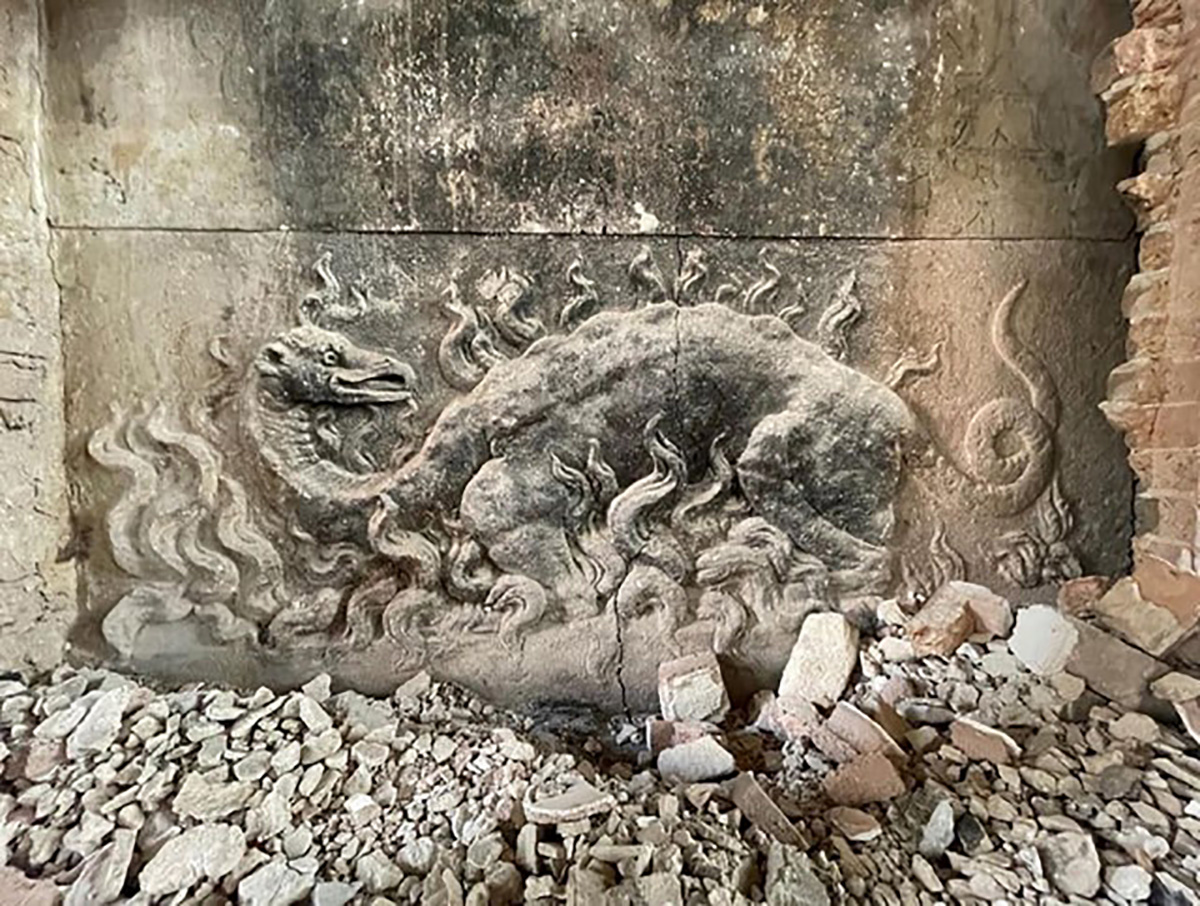
Relief Sculpture of a Salamander at Palazzo Grimani
In front of a burning salamander, can one truly approach the secret of desire?
This is the mystery that envelops the meaning of the salamander carved into a fireplace in one of the rooms of Palazzo Grimani, discovered only a few years ago during restoration work.
The Palazzo, now a state museum, is a place where Giovanni Grimani’s passion for classical culture, mythology, and its symbols intertwines with his personal story and his family’s history.
Giovanni Grimani and the Palace
Purchased at the end of the fifteenth century by the future Doge Antonio Grimani, the palace was enriched with extraordinary collections of ancient statues, books, and coins thanks to his son, Cardinal Domenico Grimani, a humanist and refined collector.
It was, however, the determination of his grandson Giovanni, combined with his refined taste for art and his ability to bring together extraordinary talents, that transformed the palace into a true masterpiece of sixteenth-century humanism.
A man of vast culture and a restless spirit, Giovanni—though bishop of Ceneda and later patriarch of Aquileia—frequented intellectual circles often suspected of Lutheran sympathies. A charge of heresy initiated a long investigation by the Inquisition, which, although it ended in acquittal, cost him the cardinal’s hat. Giovanni experienced the missed appointment as a humiliation and an injustice.
After his uncle and two brothers had received the title, he believed he had full right to it as well.
Haunted for the rest of his life by the “devils” of the Holy Office, Giovanni transformed the family palace into the place of his vindication, where he could respond to the affront and reclaim his innocence.
He summoned leading artists of Roman Mannerism, such as Giovanni da Udine and Giuseppe Salviati, as if to answer Rome with the same artistic language then in vogue in the papal city.
In the mythological stories narrated through stuccoes and frescoes in the palace’s halls, the tales of men and gods come to life, along with the ancient and ever-persistent dynamics of guilt, punishment, and redemption.
The Salamander
It is precisely in the wing of the palace that Giovanni had decorated in the late 1530s, in the room once dedicated to Psyche, that an ancient flue was uncovered behind a wall. Once the debris was removed from the fireplace, a magnificent bas-relief appeared inside: a salamander that seems to dance among the flames that surround it.
One can imagine that, when the fireplace was lit, a spectacular scene would unfold: the creature shimmering in the fire and whirling among the flickering flames, like a shadow puppet escaped from its theatre. Yet, when the last log in the hearth had burned out, the salamander, moments earlier an ethereal body, would return to stone. Carved in matter and blackened by soot, the creature embodying desire remained there, a tangible presence, ready to burn again.
While the salamander at floor level served as a hypnotic focal point that captured the gaze of those present, on the ceiling shone Francesco Salviati’s sensual canvases depicting the stories of Cupid and Psyche, a reminder that, like humans, even the gods endure the torments of passion. The frescoes and the salamander formed a symbolic unicum: a tribute to the power of love, both human and divine, capable of overcoming even the harshest trials.The tale, narrated in The Metamorphoses by Apuleius, tells how Venus, Cupid’s capricious mother, did everything in her power to hinder the love between her son and the beautiful princess Psyche. Yet the young woman courageously faced relentless challenges, eventually achieving immortality and earning Venus’ consent to the marriage.
Thus, the theme of the tale, together with the salamander, celebrated the triumph of desire. The tenacity of passion and the ability to endure the harsh trials it sometimes imposes were ultimately sublimated into a divine force, capable of leading to the bliss of love and the union of human and divine.
Despite the thematic coherence of the room, the creature, with its many symbolic references, also evoked Giovanni Grimani’s moral strength and the unwavering faith that allowed him to withstand the accusations and persecution of the Inquisition.
The Metamorphoses
The themes of the two subsequent rooms, inspired by The Metamorphoses of Ovid, are dedicated to the nymph Callisto—transformed into a bear by Juno and then into a constellation by Jupiter—and to Marsyas, the reckless satyr who, after daring to challenge Apollo to a musical contest, was flayed as punishment for his hubris.
Once again, we witness the injustices of the gods: while Cupid and Psyche’s story ends in happiness after their suffering, the only way to save Callisto from her fate was to immortalize her among the stars. As for Marsyas, all that remains of him is a memory, preserved in the name of a river, born from the tears of pity shed by the woodland deities.
In mythology, metamorphosis becomes the instrument through which the gods attempt to redress the wrongs that, often out of vanity, they inflict upon lesser gods or mortals.
In the same way, Giovanni Grimani transformed the palace into a testament to his life, entrusting art with the task of restoring justice to his story and leaving it as a legacy for posterity.
Almost half a millennium later, walking through these halls, one can still hear his voice echoing—perhaps only a whisper of vindication, left in the care of history.
La Bella, Portrait by Titian, 1530s, Portland Art Museum. Model unknown.
Imagine a young woman, beautiful and self-assured: some might call her audacious.
She must have been enchanting when singing or playing the viola da gamba, often alongside her sister Cassandra, in their maternal home in San Trovaso, a lively gathering place for musicians and writers. Many offer her their verses, some even propose marriage. But Gaspara cherishes her freedom—both amorous and intellectual—and delights in composing sonnets, which she recites in the refined salons of Venetian society.
Born in Padua around 1523, Stampa moved to Venice with her mother and siblings after her father’s death. Well-integrated into the city’s cultured circles, she was admired for her poetic and musical talents. Both her mother and brother allowed her to freely express her artistic vivacity, a condition that set her apart from her contemporaries.
Gaspara was often overwhelmed by love. At the home of the noble Domenico Venier, she met Collaltino di Collalto, an aristocrat from Treviso, who combined a career in arms with a passion for poetry. She fell for him at first sight, entrusting the turmoil of that fatal encounter to her verses: “What wonder it was that at the first assault, young and alone, I was caught in the snare,” she writes in one of the sonnets dedicated to him.
It was an all-consuming love, supported by their shared passion for poetry. However, Collaltino, though fascinated by Gaspara, did not fully return her feelings. Preoccupied with his Treviso estate and his relationship with Henry II of France, whom he served as a man of arms, he was often absent from Venice.
Gaspara was consumed by torment, and the knowledge that other men loved her brought no solace. “He flees from me; I pursue him; others pine for me.” In three stark phrases, Stampa captures the paradox of loves that chase each other without ever meeting, a whirlwind of desire and disappointment that becomes all the more bitter.
With the same disillusionment, she acknowledges the weakness of Collaltino’s affection: “I am so weary of waiting (…) and he lives happily on his hills.” When Collaltino, after three years of an unstable relationship, left her for good, Gaspara was devastated: “From then on, I have trembled and sweated, wept, despaired, and desired.”
Yet, unexpectedly, after some time, Gaspara fell in love again: “I feel a fire equal to the first,” she writes in one of the fourteen sonnets dedicated to Bartolomeo Zen, her last and more stable, more fulfilling love.
With renewed enthusiasm, the poet confesses in one of her most famous sonnets that love is for her a condition of life: a fire that nourishes and regenerates her, like the salamander with which she identifies:
Love has made me such that I live in fire,
like a new salamander in the world, and like
that other no less strange creature,
that lives and breathes in the same place. All my delights and my joy,
are to live burning and not feel pain,
to not care whether he who causes this
has pity on me little or much. Hardly had the first flame been extinguished,
than Love lit another, which, as I feel,
is even more alive and greater than before. And I do not regret burning in love,
so long as he who has newly won my heart
remains satisfied and content with my fire.
Gaspara Stampa died of fever at just 31 years old, in 1554. That same year, her sister Cassandra oversaw the publication of Rime, over three hundred Petrarchan sonnets in which the poet poured out her feelings with great immediacy.
Yet, after her death, her poetry fell into oblivion.
Only with the 1738 edition, curated by a descendant of Collaltino, were the Rime rediscovered and recognized as a masterpiece of Renaissance female poetry. Despite 19th- and early 20th-century criticism, which found Gaspara’s candor shocking and considered her bold style fitting only for a courtesan, today, Stampa’s dignity as a cultured and free woman has been restored. Her writing is celebrated for its intellectual vitality, as it legitimizes feelings such as passion and desire for women, helping to redefine the female role in Renaissance literature.
Gentleman by Lorenzo Lotto, 1520s, Gallerie dell’Accademia di Venezia
Pale, emaciated, tense; his eyes gaze into nothingness, his body leans awkwardly against the table.
Long fingers mechanically leaf through a heavy ledger, while behind him, a hunting horn and a lute hang on the wall, telling of a phase of life now past: a lighter, more carefree time, devoted to music and hunting.
Next to these symbols of leisure, through the open window behind him, a landscape of rolling hills under a vast blue sky hints at spaces of freedom now curtailed.
New duties and responsibilities await him: on the table, covered with a green cloth, lie the tools of his trade— a chest for keeping the ledger, a few letters, a seal ring, and an inkwell. The index finger of his right hand hovers just above a letter, distinct from the others: it has been opened and refolded and now rests among withered rose petals. Perhaps a sign of lost love, a faded connection.
In the face and demeanor of this young man, everything speaks of resignation and inner turmoil. The light accentuates the sharp, sorrowful features of his face, amplifying the sense of profound solitude.
On the blue shawl carelessly draped over the table, in the spot where the fabric folds, a small salamander appears. Its neck stretches toward the young man, creating a tension parallel and opposite to that of his pointing finger. There is a perceptible arcing movement, starting from his right hand, passing through the scattered petals on the table, and culminating in the salamander, which draws the eye toward his left hand and the pages of the book.
The scene suggests a cause-and-effect narrative: a romantic disappointment drives the young man to seek a new purpose in life. Yet, despite the melancholy that pervades the work, the presence of the salamander hints at the possibility that the protagonist will endure his sorrow, finding strength and solace in dedication to his work.
The palette is limited to a few cool tones—blue and green—that create an atmosphere of restless calm. However, dark hues dominate much of the composition—the somber clothing, the background—heightening the dramatic impact of the young man’s pale, anguished expression and the austerity of the setting.
Thanks to his deep psychological insight and his ability to capture the subtle emotional nuances of his sitters, Lorenzo Lotto holds a prominent place in the history of Renaissance art. In a cultural climate that celebrated human passions, Lotto’s patrons often sought to expose their innermost feelings in portraits intended to be seen and admired by visitors to their homes.
Thus, the Young Gentleman entrusts himself to the artist’s hand to immortalize an indelible moment in his life.
The portrait, perhaps once hanging on a wall in a noble residence, served as a tangible testament to a painful decision and a profound anguish that Lorenzo Lotto masterfully transformed into an image of extraordinary emotional intensity, capturing the protagonist’s inner torment for eternity.
Michael Maier, Salamander, 1617, Engraving in “Atalanta fugis”.
Since ancient times, this small black amphibian with yellow spots has embodied the extraordinary virtue of withstanding the destructive force of fire unharmed.
A cold-blooded creature and lover of damp environments, it was said to feed on flames to warm itself. Moreover, when threatened, the salamander secretes, through its venomous glands, a liquid capable of causing immediate inflammation in its predator—a trait that over time has reinforced its symbolic connection to fire.
In the Middle Ages, fire, and in particular the stake, became the weapon used to incinerate the bodies and souls of sinners, purging them of the evil that had corrupted their lives. The salamander, which instead resists fire, was associated in medieval Bestiaries with the courage of those who voluntarily stifle their earthly passions, choosing to live the virtuous life of a good Christian.
With the Renaissance, the symbol of the salamander acquired new meanings. In carnal love, often evoked as a devouring fire, not only sin but also the fragility of human nature is recognized, incapable of escaping its enchantment. The lover cannot resist this amorous fire that envelops, burns, and consumes; they feed on it, torn between agony and joy. The desire to revel in this cruel and sweet torment finds one of its boldest expressions in poetry, sublimating itself in the symbol of the salamander.
In the upcoming articles, I will guide you through three representations of the salamander: in art, sculpture, and poetry of the Venetian Renaissance, all united by a red thread—the thread of passionate love—that binds them together.
Regata Storica. Since the 1950s, the water parade has recreated the triumphant reception of Caterina Cornaro, Queen of Cyprus, upon her arrival in Venice in 1489 after her abdication in favor of the Republic.
The idea of a queen for the Republic of Venice could only ever exist as a scenic fiction—an aesthetic and symbolic representation of power that actually rested in the hands of a small male council. Yet, even the Republic contributed a true queen to Mediterranean history: Caterina Cornaro, Queen of Cyprus.
A Tumultuous Background
The Kingdom of Cyprus, ruled by the French Lusignan dynasty, was, in the latter half of the 15th century, shaken by the ambitions of James II, known as “the Bastard,” the illegitimate son of James I. He usurped the throne from his sister, Charlotte. After an initial failed attempt supported by the Venetians, James turned to the Sultan of Egypt. With the aid of Mamluk troops, he deposed his sister and seized Famagusta from the Genoese, who supported her.
Amid an atmosphere of conspiracies and betrayals, James began to fear a potential defection of the Mamluks still stationed on the island. According to chronicles, he had them massacred a few years later. His precarious position as an illegitimate king convinced him to seek a wife who could secure an alliance with a powerful state. After various complications, his choice fell on the young Caterina Cornaro.
It is said the ambassador selected her for her beauty – she was apparently also a natural blonde -, but her family’s influence likely mattered more. The Cornaro family held estates in Cyprus and was among the most influential in Venice. Through marriage to Caterina and the concessions he promised the Republic, James II ensured the ally he needed.
For Venice, it was an exceptional opportunity to strengthen its military and economic presence in the eastern Mediterranean, where the growing Ottoman threat loomed ever larger.
In 1468, Caterina was betrothed to the King of Cyprus. She was only fourteen, and fortunately, the marriage was formalized by proxy. Her husband, it seems, was in no hurry; he preferred a life of leisure and lovers, with whom he even had children. When James II drew closer to the King of Naples, the Venetian Senate, fearing a shift in alliances, insisted he honor his commitments. The king relented and, in 1472, sent a ship to Venice to fetch his young bride.
Caterina’s Journey to Cyprus
The Senate bestowed upon Caterina the title of “adoptive daughter of Venice,” an honorific created specifically for her. The Doge himself accompanied her to San Nicolò di Lido aboard the Bucintoro, the golden State galley. The Republic granted her all the honors befitting a future queen, but with the title of “daughter,” they reminded her where her loyalty should ultimately lie.
The royal wedding took place in Nicosia’s cathedral amid celebrations and the enthusiastic acclaim of a crowd welcoming their new queen. Unfortunately, this union was not destined for happiness. On an island seemingly pacified, James II’s reign was short-lived. A few months later, the king died under mysterious circumstances—possibly of food poisoning—leaving his wife pregnant and as the sole heir to the island.
Not yet nineteen, Caterina ascended to the throne as regent for her unborn child, facing turbulent times of conspiracies. The situation escalated when her son was taken from her, and she was forced to sign the island’s cession to Charlotte.
A Kingdom Reclaimed
At that point, Venetian galleys stationed nearby intervened, killed the conspirators, restored order, and took control of both the island and its queen.
Amidst intrigue and conspiracies, Caterina’s position was too precarious for her to remain in charge of such a strategically important kingdom for the Republic. The Senate surrounded her with administrators and officials, politically isolating her and stripping her of power. Caterina remained queen in name only.
Shortly thereafter, her son also died of malarial fever. Without husband or child, caught between pro-Mamluk and pro-Genoese factions and subjected to Venetian domination, Caterina continued to manage what little autonomy she retained. Though she had no authority, the queen displayed regal pride and tenacity.
Rumors, unsupported by documentation, suggested that Caterina had a lover. The possibility of a new marriage added to Venetian anxieties. The government feared that a husband opposed to the Republic’s interests or new heirs could legitimately claim the throne. This concern led Venice to rid itself of a troublesome queen.
The pretext came with yet another conspiracy in 1488, instigated by Cypriot nobles. Once again, the Venetians occupied the island, and this time the Senate, through Caterina’s brother Giorgio, officially requested her abdication. Caterina refused.
Bernardino Contin, Funeral Monument of Caterina Corner, 1580, Church of San Salvador. The Queen lays the crown of Cyprus in the hands of doge Agostino Barbarigo
The Time of Obedience
Family pressures, appeals to her duty, and the urgency of her safety were futile; the queen would not yield. Faced with her obstinacy, the Republic resorted to explicit threats: the loss of her wealth and the status of a rebel. This ultimatum left Caterina no choice—a rebel was at the mercy of any assassin.
In 1489, alongside her brother, Caterina boarded a Venetian galley commanded by her cousin. Trapped by familial and political constraints, she had no escape. Dressed in black, she left Cyprus forever.
At San Nicolò di Lido, the same Bucintoro that had escorted her as a future sovereign awaited her. However, a new Doge now stood on the gilded galley. This was Venice: every glory had its expiration. A Doge died, another was elected; even a queen lasted only as long as the state’s interests allowed.
After a solemn ceremony, Caterina was sent into exile. The government allowed her to retain her titles and the lordship of Asolo, today one of Italy’s most beautiful villages, where her family owned property.
Even on the remote hills, Caterina was able to assert her regal nature.
A Court of Arts in Asolo
She won the people’s affection through significant initiatives: reforming the administration of justice, founding a Monte di Pietà, a public pawnshop, and dedicating much of her land to cultivation. During the 1505 famine, she imported grain from Cyprus to feed the population.
She also expanded the castle, built a “barco” (a villa), and invited artists, poets, and musicians. Her court became a cultural hub that attracted the era’s finest talents. The poet Pietro Bembo dedicated his *Asolani* to her, and others wrote panegyrics in her honor. Lorenzo Lotto painted an altarpiece for the local church, while Giorgione enjoyed music and perhaps painted frescoes in her villa.
Caterina transformed a small town into a kingdom of the arts.
When the War of the League of Cambrai brought Emperor Maximilian’s troops to the Treviso area in 1509, she returned to Venice, where she died the following year.
Caterina in Two Portraits
Two portraits of this indomitable queen stand out—one depicting the woman, the other her myth.
Gentile Bellini, Caterina Corner, 1500
Tiziano, Caterina Corner as Catherine of Alexandria, 1542
The first, by Gentile Bellini in 1500, portrays Caterina at forty-six, slightly heavyset, wearing gold-embroidered garments and long strands of pearls. A crown sparkles on her head. She is shown in three-quarter profile; her expression is stern, her eyelids drooping slightly, giving her gaze a shrewd, narrow look. Her lips are closed, yet there seems to be a shadow of a smile. I imagine her posing for the painter, perhaps urging him not to be timid and to capture her aging face as it was, with the weight of her history. And to not hold back with the gold. Beauty fades, but honors endure. This is how she would be remembered as a queen.
Quite different is the portrait Titian painted thirty years after her death. Caterina appears as a beautiful, sensual woman dressed in Oriental style. Her image merges with that of Saint Catherine of Alexandria, suggested by the wheel, perhaps an allusion to the queen’s Christian virtues. Yet, this image is too sensual for a saint—even too much for a queen. Here, Caterina has already become part of the Venetian myth.
If the wheel implies her Christian faith, a modern viewer may also see an allusion to personal martyrdom. Less cruel than the Alexandrian princess’s, yet serving the same purpose: to subdue a woman who had dared challenge the authority of the Republic.
Giambattista Tiepolo, Neptune Offering Gifts to Venice, 1740-45. Doge’s Palace.
Walking through the Doge’s Palace, there are moments when time seems to stand still. You lift your gaze, and among the gilded frames of the ceilings, Venice appears.
Against the backdrop of a lapis lazuli sky, she continues to reign as the immutable Queen of the Seas. Blonde, triumphant, holding a scepter, dressed in gold and ermine, or receiving a crown: Venice as a queen. This is how Paolo Veronese portrayed her during the Renaissance, and, two centuries later, Tiepolo, his prolific successor, did the same.
In the Renaissance, Venice was the capital of a powerful Republic, and its image had to be entrusted to artists capable of translating the government’s cultural strategy into art, celebrating, with each brushstroke, the myth of an invincible and enlightened Serenissima.
When Paolo Veronese was called to contribute to the decoration of the Hall of the Council of Ten in the Doge’s Palace, he was not yet twenty-five years old, but he already possessed extraordinary talent in the use of luminous, rich, and vibrant colors.
Paolo Veronese, Venice Receiving the Symbols of Power from Juno, 1555
Paolo Veronese, Venice enthroned with Justice and Peace, 1577
Paolo Veronese, Triumphant Venice, 1582
In Venice Receiving the Symbols of Power from Juno, Veronese depicted a youthful Venice in ecstasy before the goddess: her right arm outstretched to receive the gold coins, the ducal horn, and the royal crown that consecrate her as Queen of the Seas. The exchange of gestures and glances between the two queens seals the alliance between Venice and the most powerful goddess of Olympus.
More than twenty years later, Veronese left another majestic image of the Queen of the Seas in the Hall of the Collegio: seated on a throne beneath a canopy, her gaze fixed on an invisible horizon. At her feet, Justice and Peace, dressed in silk and brocade, stand as the handmaidens of a just and secure realm. One holds a sword and scales, the other an olive branch; together, the three figures form a composition in which the fate of the Venetian Empire appears to rest in steady female hands.
A few years later, Veronese was commissioned to create a Triumphant Venice for the ceiling of the Great Council Hall, where the nobles gathered to govern the Republic. The Queen appears again, resplendent in gold, surrounded by twisted columns and a multitude of people who acclaim her. Victory approaches with the crown, but this time, despite the exuberance of the draperies and colors that surround her, Venice seems to feel the full weight of this honor. Her gaze turns toward her people, but it is a more uncertain, perhaps melancholic look compared to the splendid sovereign depicted for the Collegio.
On the balustrade, noblewomen appear alongside their children and nurses: once again, the allegory of power is expressed through female figures—who, in reality, held little autonomy and even less political influence.
Observing these works in chronological order, Veronese’s queen seems to age alongside the Republic: from the dreamy young woman before Juno to the imperturbable sovereign supported by Justice and Peace, to the Triumph, burdened by a heavy cost.
Two centuries later, Gian Battista Tiepolo, the last great seducer of Venetian art, a creator of a sensual world of bare flesh, jewels, and silks, offered in the Hall of the Four Doors an image of a Queen that, in both theme and vibrant colors, recalls Veronese.
The braided blonde hair, the crown on her head, and the ermine cloak evoke the distant master, but the shimmering light that almost dissolves the matter, the darker blue of the sky, and her heavy eyelids tell of a magnificent and weary ruler. A power slipping away, leaving room for an ineffable presence destined to remain in memory.
Venice was leaving history, ready to cross the threshold into myth.
Anna Maria Maiolino, Entrevidas, 1981/2000. Maiolino, zusammen mit Nil Yalter, wurde mit dem Goldenen Löwen für das Lebenswerk auf der Kunstbiennale 2024 ausgezeichnet..
Die Biennale von Venedig ist mehr als nur eine Kunstausstellung – sie ist ein immersives Kunsterlebnis. Alle zwei Jahre verwandelt dieses Ereignis Venedig in eine dynamische Leinwand der Kreativität.
Die Veranstaltungsorte: Giardini und Arsenale Die Biennale findet an zwei historischen Orten statt – den Giardini und dem Arsenale. Die Giardini sind ein malerischer Park, gespickt mit charakteristischen Pavillons, von denen jeder verschiedene Länder repräsentiert. Diese Pavillons, die über die Jahre hinweg umgestaltet und erneuert wurden, spiegeln die wechselnden künstlerischen Visionen und Politiken ihrer jeweiligen Länder wider.
Die Hauptausstellung, organisiert von der Biennale-Stiftung, befindet sich im zentralen Pavillon in den Giardini und in der Corderie (ehemalige Seilfabrik) im Arsenale. Renommierte Kuratoren wie Jean Clair, Harald Szeemann, Robert Storr und Massimiliano Gioni haben in früheren Jahren die Verantwortung übernommen. Dieses Jahr ist der Kurator Adriano Pedrosa.
Die Länderpavillons zeigen Künstler, die auf unterschiedliche Weise in ihrem eigenen Land ausgewählt wurden, sei es durch Kulturministerien oder Expertenkomitees. Diese kleine unabhängige Ausstellungen können mit dem Hauptthema der Biennale verbunden sein – dieses Jahr “Überall Fremde” – oder ein anderes Thema haben.
Beim Bummel durch die Biennale begegnen Sie einer erstaunlichen Vielfalt an Kunst – von Installationen und klassischen Stücken bis hin zu Kunstvideos und Live-Performances. Jeder Pavillon ist ein Tor zu einer einzigartigen künstlerischen Welt.
Das Arsenale, die ehemalige Werft der Republik Venedig, besteht aus einer Reihe von Schuppen aus dem 16. Jahrhundert. Der längste davon, die Corderie (Seilfabrik), ist jetzt ein Raum, in dem Kunstwerke ununterbrochen ausgestellt oder in Mini-Pavillons organisiert werden.
Andere Schuppen, einst als Docks für den Schiffbau genutzt, sind nun in Pavillons umgewandelt, die verschiedenen Ländern für ihre nationalen Ausstellungen zugewiesen werden.
Während Sie durch das Gelände gehen, tauchen Sie in eine Umgebung ein, die mit Jahrhunderten maritimer Geschichte widerhallt.
Besuchstipps: Um den Biennale-Geist vollständig zu erleben, erwägen Sie, Ihren Besuch auf zwei Tage zu verteilen. Beginnen Sie mit den Giardini, und nehmen Sie sich Zeit, in den Cafeterias zu entspannen oder auf einer Bank unter den Bäumen. Widmen Sie einen weiteren Tag dem Arsenale für ein komplettes Erlebnis.
Über die traditionellen Veranstaltungsorte hinaus: Mit zunehmender Beteiligung ergießt sich die Biennale in Venedigs Kirchen, Paläste und andere Räume und verwandelt die Stadt in eine lebendige Freiluftgalerie, die einen zeitgenössischen Schnappschuss globaler Kunst bietet.
Verpassen Sie nicht die Chance, Teil dieser unvergleichlichen Kunstreise in Venedig zu sein – wo jeder Besuch Sie bereichert und inspiriert zurücklässt.
This website uses functional cookies only.
Diese Website verwendet nur funktionale Cookies.
Questo sito utilizza solo cookie funzionali.
Functional
Always active
The technical storage or access is strictly necessary for the legitimate purpose of enabling the use of a specific service explicitly requested by the subscriber or user, or for the sole purpose of carrying out the transmission of a communication over an electronic communications network.
Preferences
The technical storage or access is necessary for the legitimate purpose of storing preferences that are not requested by the subscriber or user.
Statistics
The technical storage or access that is used exclusively for statistical purposes.The technical storage or access that is used exclusively for anonymous statistical purposes. Without a subpoena, voluntary compliance on the part of your Internet Service Provider, or additional records from a third party, information stored or retrieved for this purpose alone cannot usually be used to identify you.
Marketing
The technical storage or access is required to create user profiles to send advertising, or to track the user on a website or across several websites for similar marketing purposes.