
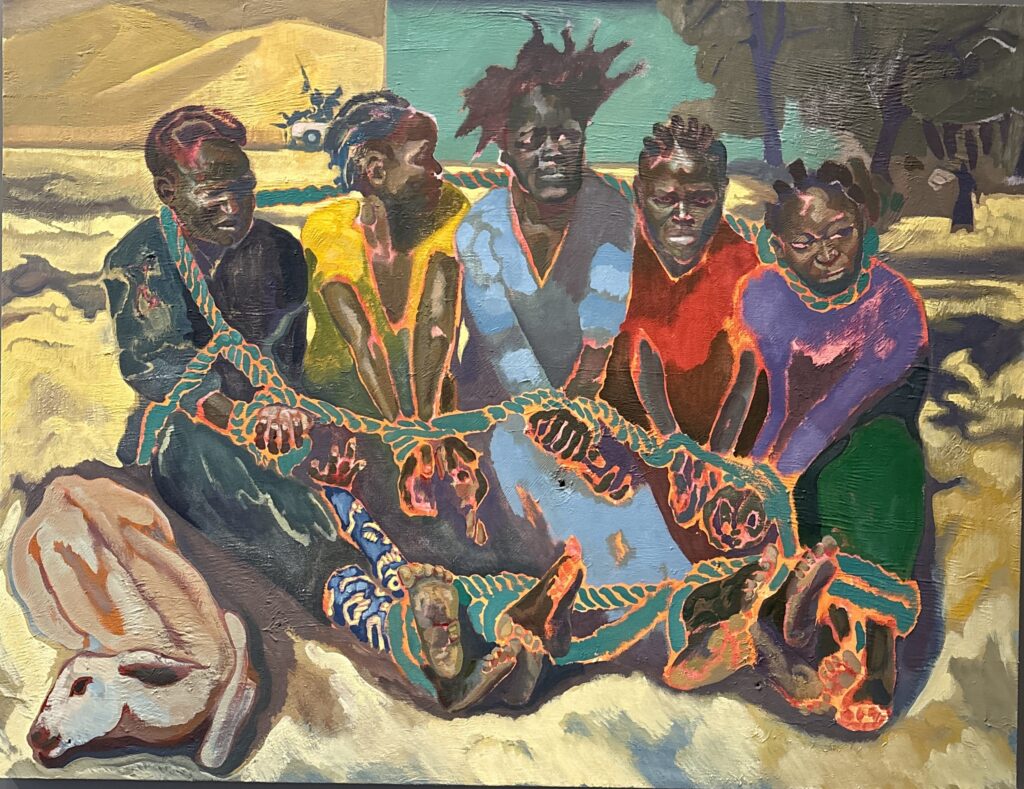
There is an exhibition at Palazzo Grassi dedicated to Michael Armitage, born in Nairobi to a Kenyan mother and an English father, raised in Africa and, from adolescence, in London, where he trained at the Royal Academy. His works tell the story of contemporary Kenya.
I arrive at the exhibition as though carrying a promise in my pocket — but it is a promise the first rooms both keep and betray at once. The canvases are large, the colours warm and beguiling; the narratives often cruel.
In the room overlooking the Canal Grande, the brightest of all, I stop between two windows before a work smaller than the rest: a circular, hypnotic movement of concentric circles lifts a mother and child in a celestial spiral. It might be a secular Assumption, were it not for a distant figure in the background — like a saint who has lost his balance and is being carried off by the wind.
In that mother, her legs soaring into the blue of the sky, I recognise something. Perhaps because just across the water, at Ca’ Rezzonico, Tiepolo’s angels float — that joyful painter of bare, kicking legs. Or perhaps because, looking up at the gilded ceiling, a triumphant figure of Justice reclines on billowing clouds, stirred by a breeze that echoes the vortex below. I turn back to the woman and child before me. She has nothing of the lightness of a Madonna ascending to heaven — in fact, if you look closely, she seems to be struggling to rise. From this point on, I no longer want to ask questions. The dominant colour in the other canvases is blue: foaming, wild seas, bodies floating above them. I can no longer pretend not to understand. An overcrowded boat. A man stretches out his arm to hold his child above a landscape that has already become underwater.
I read the caption — the only way to move beyond the painting. The room overlooking the Canal Grande is dedicated to Lampedusa, or rather, to those who never managed to reach it. There are no Madonnas in this stretch of sea.
I must not let myself be deceived by Armitage’s soft colours: the green that evokes a lush Africa; the reds, yellows, and oranges of the crowds; bodies made of transparent brushstrokes that dissolve into nature itself. This is how Armitage seduces: he casts an attractive lure, then hurls you into tragedy. And he does so consistently from the very first room, where a woman in boxing gloves in the ring seems tormented by monstrous, dreamlike figures looming behind her. It is a portrait of Conjestina Achieng, the celebrated boxing champion — the first African woman to win a world title. The press destroyed her over her mental health struggles.
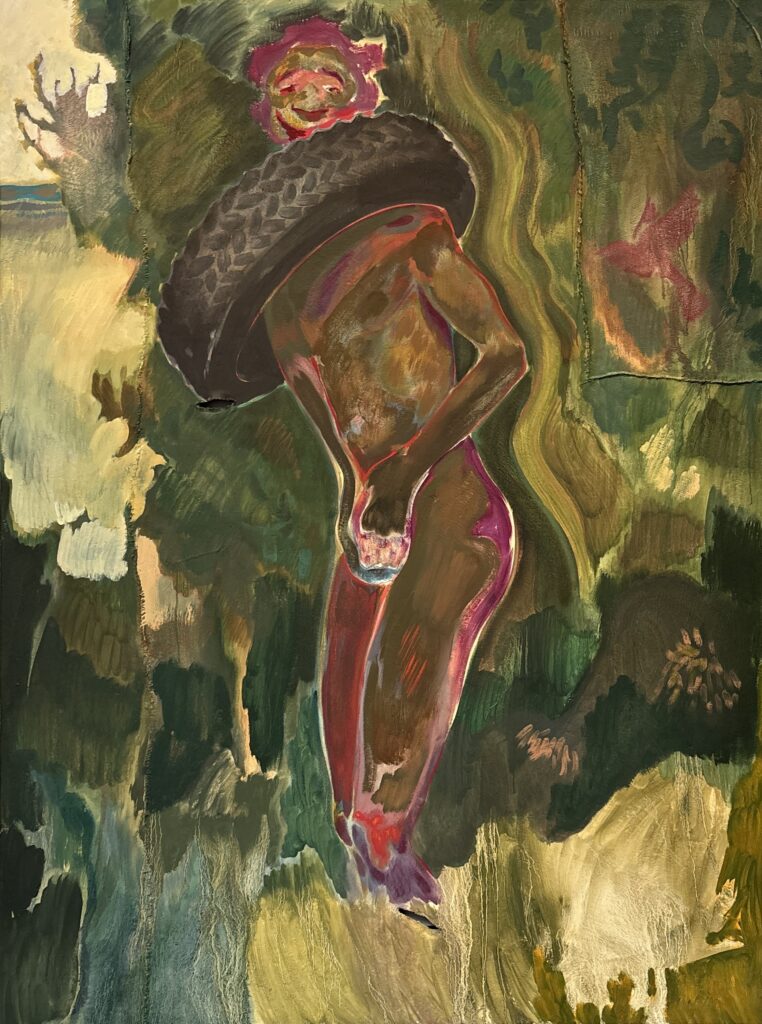
And then there is the man with a mouth painted red like a clown’s, eyes half-closed and wild, a tyre around his neck. I look around and see I am not the only one staring at him. This is a work you cannot walk away from. I look for the caption. It describes the horror of a lynching the artist witnessed as a child in apartheid South Africa. A tyre soaked in petrol was thrown around the victim and set alight. That is what those reddish flares are.
I know Africa only through novels and art, and I am steeped in that deep-rooted European fascination with the exotic. Armitage knows this, and turns it against me. He does so by using a familiar and seductive painterly language, citing Gauguin, Manet, Goya, and Picasso without reservation. As in the group of nude males against a backdrop of brown tones, where touches of gold on their genitals inevitably draw the eye. These are boys who sell themselves to tourists in Mombasa. A counterpoint to Picasso’s Bathers.
And then the disorderly, chaotic crowd during the 2017 elections. More than festive, it looks like a crowd in a frenzy, mistaking promises for truth. Why do we always deceive ourselves?
In some way, I deceive myself too. I let myself be tricked by Armitage’s skilled painting, swept along by his maddened crowd, the colours that never blare, the choral scenes. But with every caption, the enthusiasm cools.
Every scene refers back to lynchings, poverty, prostitution, violence, drugs, death. At a certain point, I lose faith. I could stop at the canvas and seek no further information. I could remain on the threshold. Instead, I read on.
I move closer to the canvas: there are holes that eat into the brushstrokes, and long raised ridges like scars that give it an organic, tactile quality. This is not linen but Lubugo — a fabric from Ugandan tradition, still linked in some cultures to funeral rites. It is made from the bark stripped from fig trees, then softened, beaten, and worked by hand. The fabric remains imperfect; the brush must negotiate with its grooves and tears. Armitage had found some pieces at a souvenir stall a few years ago. That material became for him the body on which to write the history of contemporary Kenya — a country that British colonialism left with wounds still open.
I find myself wondering whether Armitage, born in 1984, carrying both an African and a European identity, does not bear these impulses within himself.
I think back to the boxer. Perhaps she was inviting me to climb into the ring with her. Perhaps she was telling me to watch out: the blows come unexpected, and below the belt.
Only near the end of the exhibition did I catch my breath. Landscapes built from many thin brushstrokes that give an almost three-dimensional depth. But the relentless captions speak of fragile lands, disputed by men, threatened by war or pollution.
The final work shows a sleeping man. His face splits like a mask and floats in space. It is titled You, Who Are Alive — and it seems to say: I have done my part. Now it is up to you.
At least, that is what I understood.