
With Los restos, Oriol Vilanova fills the Spanish Pavilion with forgotten postcards: an immersive experience that questions our habit of looking at, choosing, and preserving images over time.
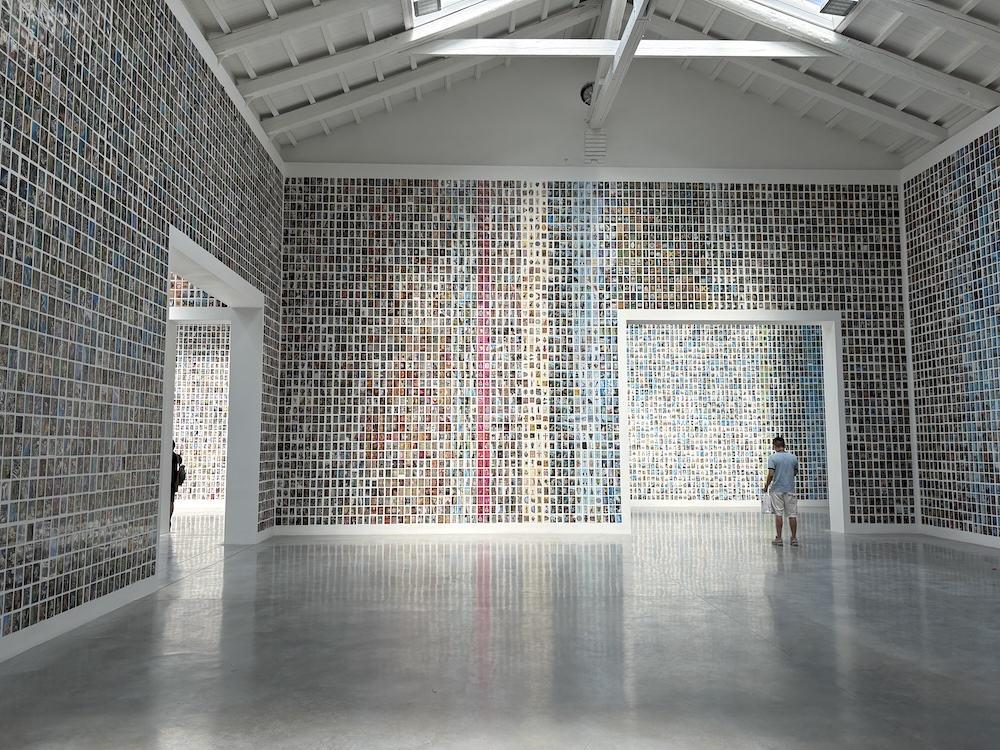
Thousands of postcards cover the walls of the Spanish pavilion, from floor to ceiling. Fifty thousand of them, they say at the entrance.
The first time I walked in, I felt overwhelmed by the contrast between the emptiness of the great rooms and the sheer excess of images. It took me a while to recover from that disorientation and begin to make out how the bright, slightly glossy colours formed pictorial waves, dominated by the blue of the sky or the white of snow. The ones showing sunsets over the sea looked, from a distance, as if made of brushstrokes of orange and black, as though Oriol Vilanova, the artist, were using the postcard as pigment, as a painter’s material.
After a while, what at first had seemed an unmanageable tide of images grew more legible. The postcards are hung vertically, even when they ought to be seen horizontally, arranged according to a grid that leaves barely a centimetre of space between one and the next. At the centre, a small magnet holds each one to its support.
Moving through the rooms, I couldn’t tell whether I felt more immersed in an ancient mosaic or in the pixels of a contemporary screen.
In art magazines, Vilanova is described as a “compulsive” collector. And yet he is also a methodical artist, one who visits flea markets with regularity. The heart of his work is buying postcards that come from emptied cellars or unsold lots — objects stripped of value that we throw away, which he sets back into circulation through a series of repeated gestures: choosing the piece, negotiating, paying.
This ritual overlays others that once accompanied the production and circulation of postcards. Each of those images had been selected by a commissioning body: the tourist office, the museum, the ecclesiastical authority. Then there was the photographer’s eye, studying the angle, the light, the framing.
At the final stage, many of us took part, following a kind of liturgy: we stopped in front of the display racks, chose the image best suited to a grandmother, a friend; wrote a greeting, bought a stamp.
That the postcard evokes for me an almost vanished custom is a personal reaction, one that does not match the artist’s intent. Vilanova states, in fact, that he follows no poetics of nostalgia, still less any wish to archive, document, or preserve — only to stage a ritual that reactivates the images.
The seemingly infinite quantity of images surrounding me suddenly feels like an echo of the digital world; even rendered through an analogue medium like printed photography, what resonates beneath it is our common habit of scrolling through images — real, false, or artificial, but omnipresent.
Despite the artist’s declared absence of nostalgic feeling for the postcard, for me it is inevitable to look for what it represents. I discover that he has arranged them not only by colour but by theme: theatres, mountains, altars, skyscrapers, archaeological remains, European monarchs, yellow flowers, cats. I feel as though I were inside an encyclopedia of human history whose pages are all open at once, and despite the artist’s words, I am overtaken by nostalgia, because within this great history there is also my own. In every image there is something I recognize, a place I would like to see, an unexpected surprise. I find again my desire to travel, places lost forever, memories of a romantic summer by the sea, a palazzo I had forgotten. There is even one with Prince Andrew and Sarah Ferguson. Who knows who bought that one.
It is a succession of emotions that return like small tremors of memory and desire.
Today it is much easier and faster: I see, I frame, I click. And if I don’t like it, I delete it. And yet I confess: the images I receive from friends stay inside the message. I no longer keep a box for postcards.
Vilanova recounts having bought his first postcard on a school trip. Over twenty years, he has gathered two hundred thousand pieces, a collection of which we see only a part, and which he calls “a novel perpetually being written.”
The title of the installation is Los restos — what remains, the remains. It is still not clear to me whether it refers to the remains of our imagination, or of human history.
Among all the thematic sections, the one I keep returning to is devoted to cave paintings. More than thirty thousand years ago, our ancestors, with earth and minerals, with their hands, with little tubes or moss pads, painted hunting scenes, left the imprints of their hands. The first gestures of our need for images. Los restos of a world that has not yet stopped leaving traces of itself.
As in a cave, I walk into the Spanish pavilion and look at what remains of us.