
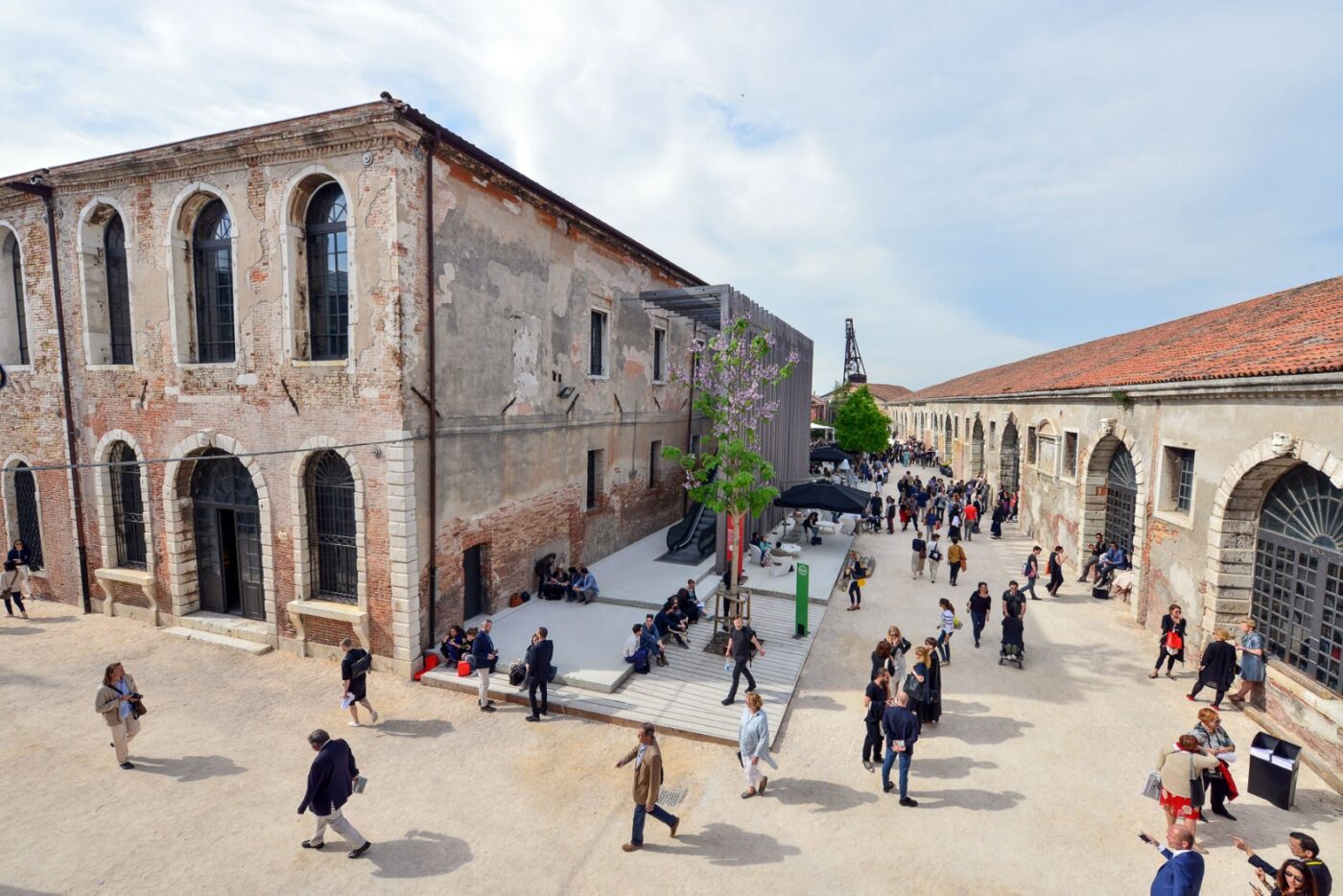
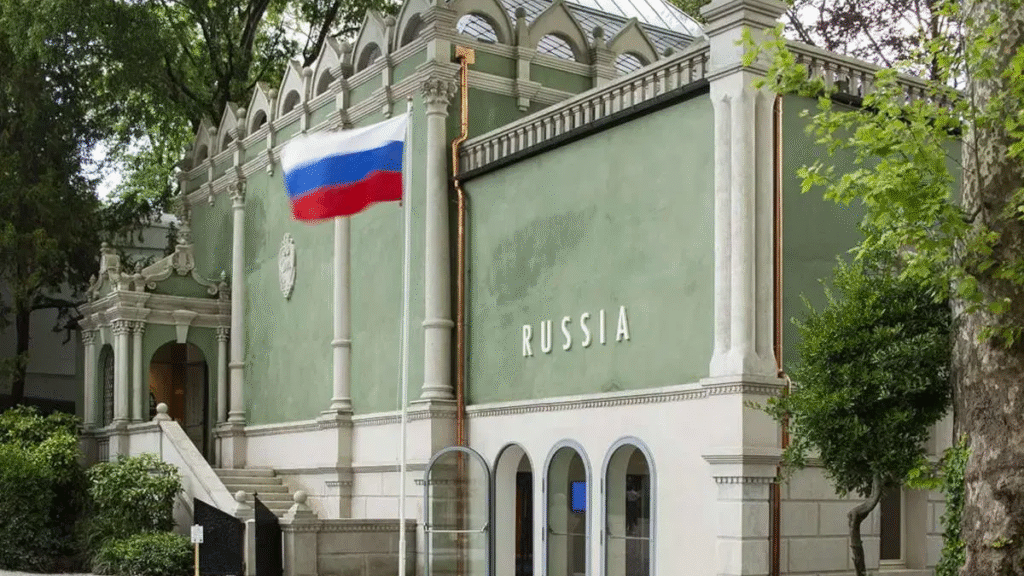
In the Arsenale, on the first floor of the Sale d’Armi, the Republic of South Africa’s pavilion will remain empty this year. The Russian Federation’s pavilion, closed since 2022, might on the other hand reopen — although the latest news seems to cast doubt on this possibility. The pavilion’s commissioner, Anastasia Karneeva, through her company Smart Art, submitted a formal request to participate, and the Biennale accepted the project.
All hell broke loose. Twenty-two European countries protested vehemently against the Russian presence, and the European Commission threatened to cut the Biennale’s funding. This happened just days after the Paralympics, where Russian athletes not only competed but won gold medals and stood on the podium to the sound of their national anthem.
The Russian pavilion’s project, The Tree Rooted in the Sky, involves some forty young musicians, poets and philosophers and is inspired by the French philosopher Simone Weil. Apparently in keeping with Koyo Kouoh’s exhibition In Minor Keys, which explores domestic, spiritual and collaborative themes.
And yet, say the twenty-two countries together with the Commission, there are fears that so much philosophy conceals a political agenda, given the verified presence of figures connected to Putin’s inner circle. The danger, in short, is that art might be used as soft power to sway visitors and weaken solidarity with Ukraine.
This kind of cultural seduction is not a new weapon: in the 1950s the United States consciously deployed it to promote Abstract Expressionism and Pop Art — in opposition to Soviet social art, certainly, but also to conquer a market still dominated by European artists.
The question is whether Russia is the only country today reaching out its claws to control and politically exploit art. And here many doubts arise.
If we return to the South African pavilion, the story is rather tangled. The artist Gabrielle Goliath, chosen unanimously by an independent commission through a process validated by a law firm, saw her participation cancelled by direct government intervention. Her project Elegy — addressing femicide in South Africa, the genocide of the Herero and Nama peoples in Namibia, and the death of a Palestinian poet under Israeli bombs — was challenged by Minister of Sport, Arts and Culture McKenzie on the grounds of being divisive.
Not content with this blow, McKenzie went on to accuse the artist of having received Qatari funding for her project — accusations that were later disproved. Goliath’s appeal to the courts was rejected, and the artist was ordered to pay legal costs. Gabrielle Goliath was thus censored and defamed. If there were voices of outrage, they never reached European institutions. Almost no trace of them can be found in the newspapers, only in art journals.
Things went better for Khaled Sabsabi, an Australian artist of Lebanese origin, also chosen by an independent commission. It all began with a newspaper article targeting a 2007 video, You, showing a Hezbollah leader in front of a crowd. The controversy grew, Parliament put pressure on the funding body Creative Australia, which yielded and cancelled the artist’s participation in the Biennale. In Australia, however, the art world rallied behind Sabsabi, and after many protests and several resignations, the artist was reinstated in the programme.
By then the video had been broadcast across all media. The most tragicomic aspect is that the politicians’ outrage concerned a twenty-year-old video, not the meditative and spiritual work conceived for the Biennale.
There is yet another case. In the United States, the government explicitly requested the exclusion of proposals with DEI content (diversity, equity and inclusion). New York sculptor Robert Lazzarini found a way around the obstacle: his mathematical distortions applied to national symbols — the eagle, the flag, Washington — were approved by the State Department. The University of South Florida, the institutional partner, failed however to raise the necessary budget. In Lazzarini’s place, through a process that was perhaps not entirely transparent, Alma Allen was chosen — a sculptor of abstract biomorphic figures unlikely to provoke any friction with the public.
Other countries too have opted for artists considered “safe”, unlikely to spring any surprises — though many Biennale enthusiasts, myself included, are hoping for the Austrian Florentina Holzinger, one of the most irreverent and unpredictable choreographers and performers on the contemporary scene.
What strikes one most, in this feverish political desire to control art, is the profound incompetence in the field — not to mention the poor understanding of what the Biennale actually is. The national pavilions, a few steps from one another, allow visitors to move from one continent to another: Korea next to Germany and Canada; in the Arsenale, the Philippines, Lebanon and Nigeria in adjacent spaces. The frictions, the affinities, the incomprehensible elements alongside the didactic ones generate visual and sensory associations, meanings and reflections that are utterly unpredictable.
The Sabsabi case is telling: his video presented the iconography of power in its most ambiguous form. Seen twenty years later, out of context, without expertise and through an ideological lens, its meaning was distorted. And if one cannot grasp a work made twenty years ago, how can one presume to decide when art becomes propaganda? The message “I won’t let you see what displeases me and what you are incapable of understanding” seems out of place in this historical moment, when news travels globally and simultaneously online.
Another episode worth recalling concerns Venice directly. In 2009, Palestine appeared at the Biennale for the first time as a collateral event — Palestine c/o Venice — and to this day Palestine has no national pavilion, despite being recognised by almost 160 states. Among the participating artists, Emily Jacir presented a project evoking the centuries-old ties between Venice and the Arab world. In stations she translated into Arabic the names of the waterbus stops along vaporetto Line 1 on the Grand Canal. The ACTV was “enthusiastic” about the project and even willing to fund it. Instead, “someone from the municipality” showed up at the management office saying that in Venice “this cannot be done.”
Jacir then produced only a paper map of the project. This is the same artist who, at the Biennale two years earlier, in 2007, won the Golden Lion.
From its very origins the Biennale has been a geopolitical instrument, offering countries a stage on which to use art as propaganda — though no one will ever be able to say whether this use has been effective. Because art exceeds the intentions of political institutions.
Art cannot be reduced to the object: the canvas, the clay, the video may remain, but the emotions, the sensations, the joy or the unease it has generated cannot be reduced. Art persists. It is a banal statement, but worth repeating — for all those who believe they can circumvent it with sanctions or regulations.
Returning to the Biennale that will open in less than two months, I wonder how much we will actually see; whether we will be struck by the works on show or rather by the absence of themes we feel are urgent and would have wished to find. It seems more likely that we will be offered an innocuous Biennale — sedative, even, at certain moments.
Will it be a Biennale of the unspoken?