
If there’s one thing this exhibition caught me off guard with, it was the scale. In the vast rooms of Ca’ Pesaro I felt out of proportion standing before those three- or four-metre canvases, where the eye had to climb across the nude bodies filling them — overflowing and imperfect.
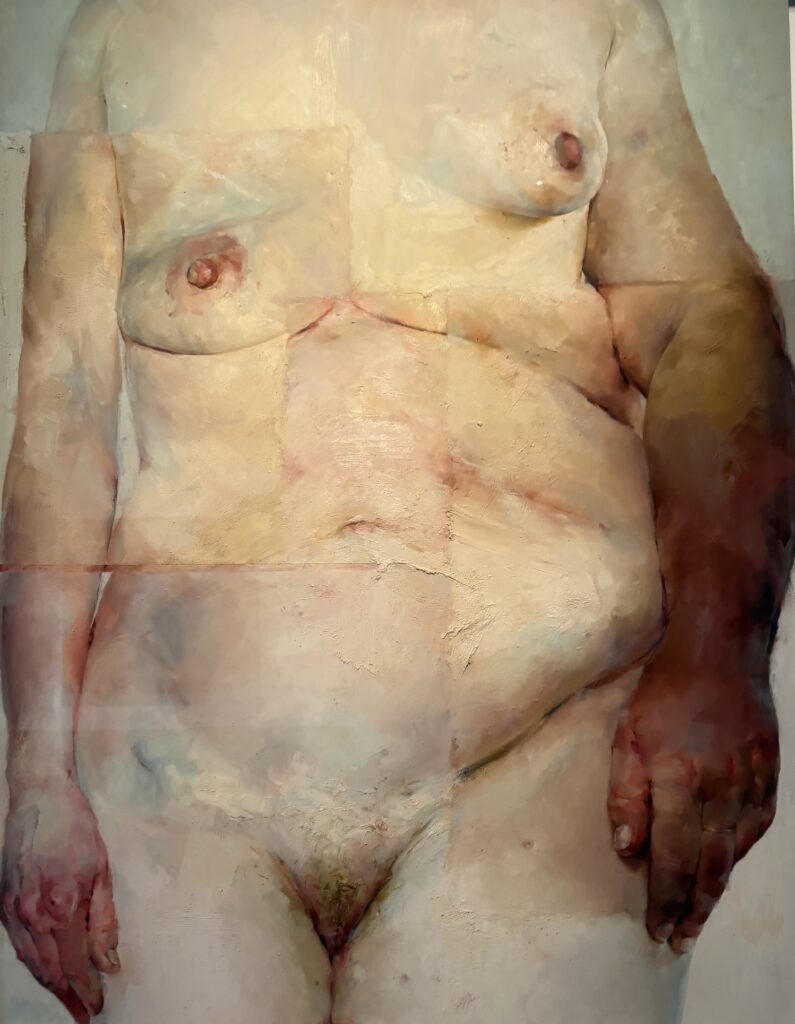
A woman digs her fingers into the tenderised flesh of disproportionate, powerful thighs; another has one breast soft and drooping, one small and firm; an arm is swollen and diseased. That these may be different bodies, assembled as if in a collage, makes it no less unsettling.
In other works the bodies multiply, intertwine, merge into one another: where does a leg end, where does an arm fall.
Three obese bodies, piled one on top of the other, bound with a cord, seem to be displayed on a counter. The brushstroke is dense, thick — it makes the fleshy masses tremble.
Those fat bodies, vulnerable in their excess, so far from any aesthetic norm, are exposed without defence.
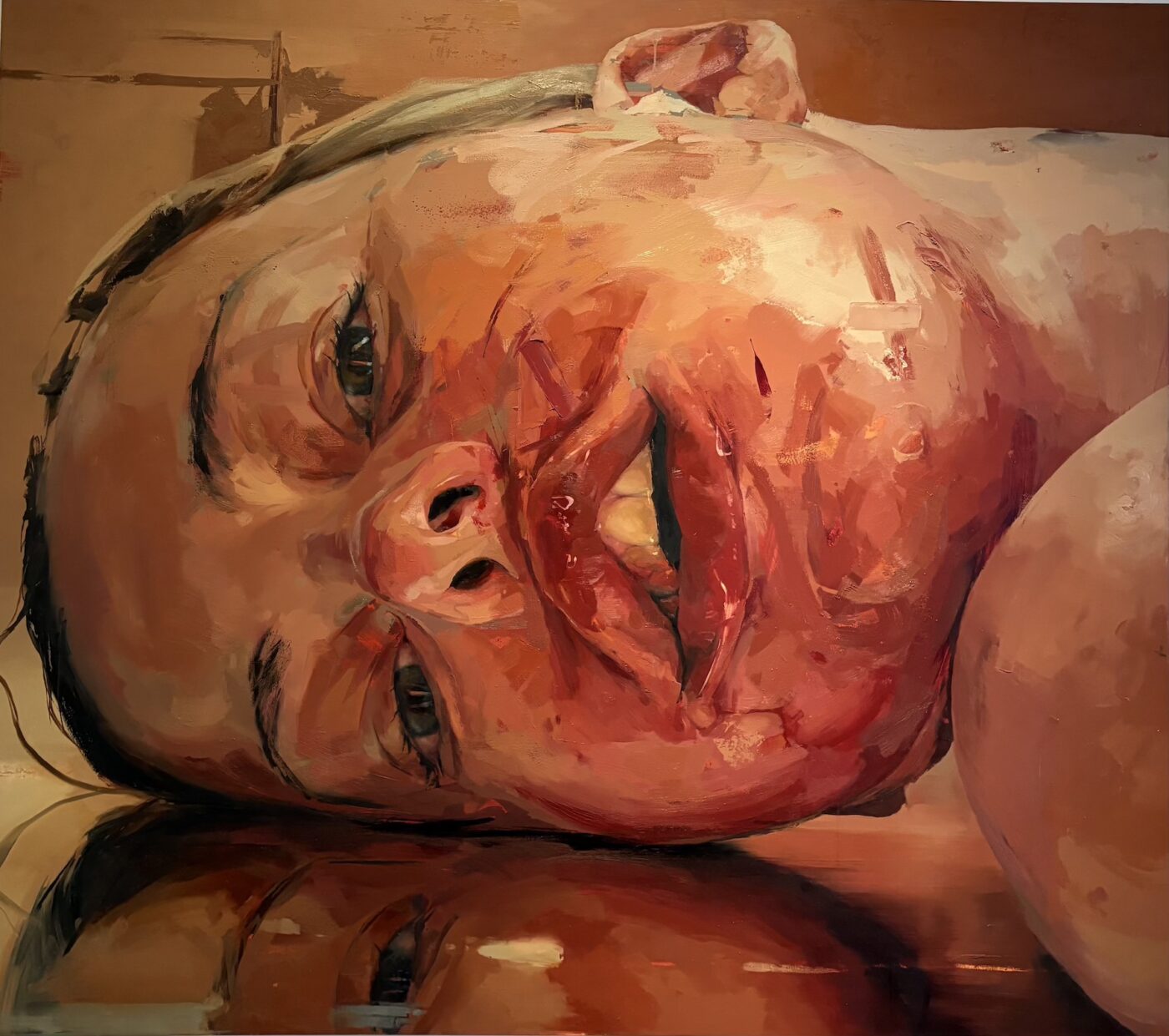
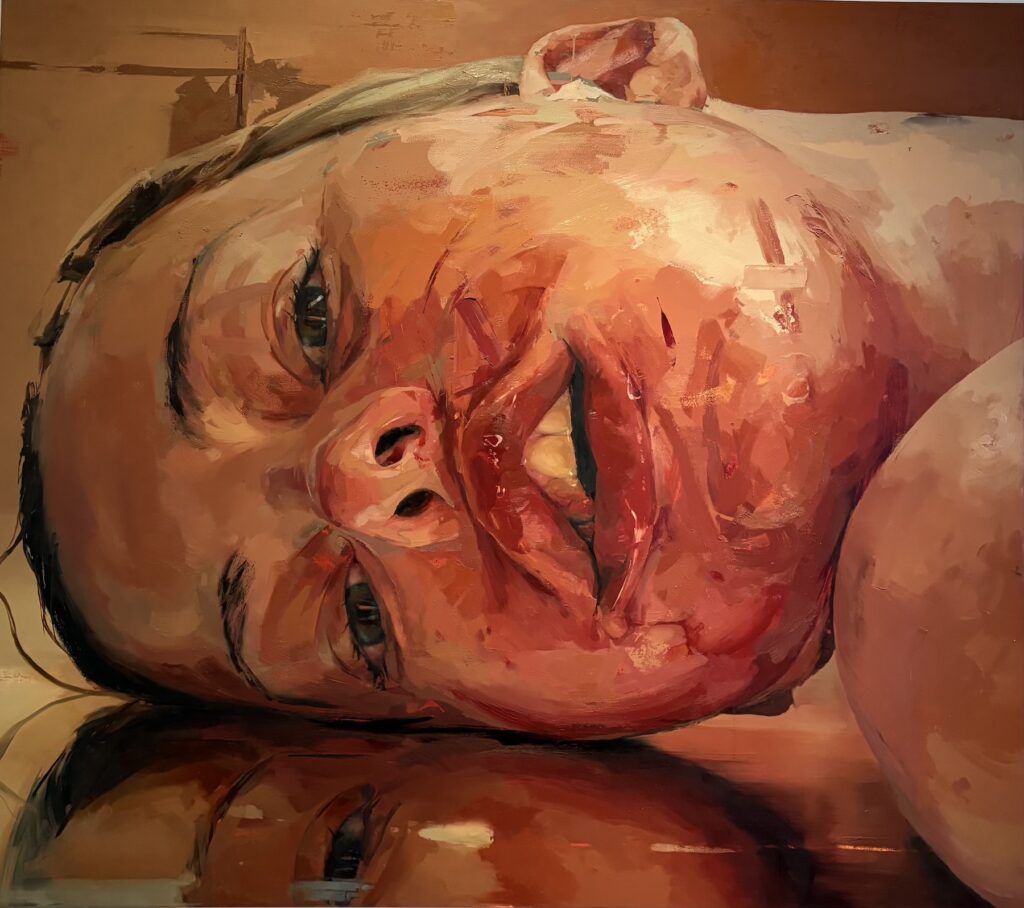
In the portrait rooms, it is always the same face looking back at us: large manga eyes, soft lips — but that beautiful face is brutalised by the paint. Reds and blues bring out swollen lips, bruises on the cheekbones, contusions on the skin. The eyes, reddened by tears, are always slightly wide and uncertain, as though they cannot understand the violence that has struck them.
The paint is sometimes heavy, applied with a palette knife, sometimes scraped or filamentous. Everything hidden beneath the smooth layer of skin seems to press outward: flesh, blood, fascia, fibres, nerves. The surface of the canvas pulses.
That face — so beautiful, so defenceless — looks as though it has been punched.
And yet, even as the emotion threatens to overwhelm you, you sense that Saville is fully inside the process of painting. Not only as an exploration of her medium — the colour, the drips, the scratches, the marks — but by portraying herself. Saville is at once model, maker, and spectator.
It is not self-examination that interests her, the artist says, but using her own face and body — photographed and enlarged — as an instrument to probe something deeper. “Beauty frightens me,” she confesses; she fears her work might “not be serious” or might seem “sentimental.”
The dialogue with the great masters of the past is explicit and conscious: Cy Twombly, Lucien Freud, Kokoschka. If I had to choose one, I would choose Kokoschka, for the charged and nervous palette.
In the room of the Pietàs, bodies are abandoned in a last embrace. The colour recedes — except for a large Madonna on a gold ground, a homage to Byzantine and Venetian painting.
Venice — a city she returns to often — is present in her work also through the Venetian masters she studies and reworks.
The final two works are a tribute to Titian. Venus and Adonis gives her the occasion to return to intertwined bodies; in the background, this time, she adds the mountains of the Cadore. Of the Danaë — the nymph possessed by Jupiter in a shower of golden rain — little remains of that idealised beauty. A plump woman approaching middle age, with red hair, looks out at the viewer: perhaps tired, perhaps indifferent to her own exposure.